



There is a bigger story behind Gemini 3.7 Flash than another model launch. Google is pushing a coding workhorse into a price range where developers can afford to use AI agents for much more work, much more often. Gemini 3.7 Flash launched on August 13, 2026 with introductory API pricing of $0.75 per million input tokens and $3.75 per million output tokens through December 31. That changes the comparison from simply asking which model is smartest to asking which model delivers enough intelligence, fast enough, at the lowest cost per successful software task.
That distinction matters because software engineering is not one giant benchmark. A team writes documentation, fixes lint errors, generates tests, audits dependencies, builds UI, refactors functions, investigates bugs and occasionally tackles a genuinely difficult architecture problem. Using one premium model for all of those jobs is increasingly hard to justify.
Build Fast with AI already has a dedicated Gemini 3.7 Flash review. This article looks at the broader economic shift: why a fast, cheap coding model can change agent architecture, team budgets and the way developers route work.
Gemini 3.7 Flash is changing AI coding economics because it turns capable coding and agent work into a lower-cost, higher-throughput workload. Google positions the model for software engineering, web development and agent workflows, and early launch coverage reports major improvements in planning, code generation and instruction following. At $0.75 input and $3.75 output per million tokens during the introductory period, it sits far below premium models such as Claude Sonnet 5 and GPT-5.6 Sol. The catch is that lower price does not automatically mean lower total cost. The correct metric is cost per successful task after retries, human review and failures. Use Flash for high-volume work, keep a stronger model for difficult tasks, and let routing decide where the extra intelligence is actually worth paying for.
The August 2026 Coding Cost Curve
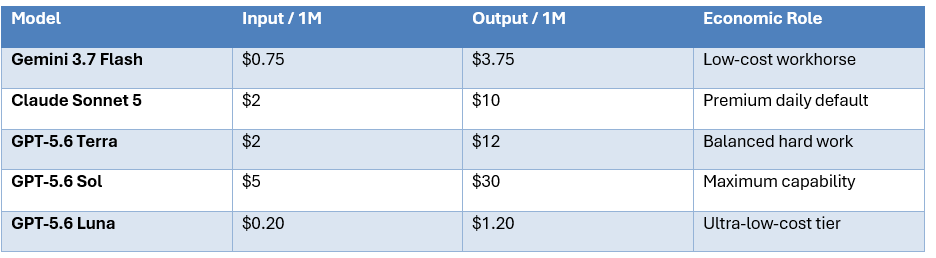
The gap is large enough that model routing is no longer a minor optimization. A company that sends millions of coding calls through a premium model can save substantial money by moving routine work to a cheaper model, provided the cheaper model still clears the team's quality bar.
1. Why Flash Models Matter More for Coding Than Chat
In a normal chat, latency is mostly a convenience issue. In a coding agent, latency becomes part of the execution loop. The agent may search a repository, read files, write code, run tests, inspect errors and repeat several times before completing one task.
If every step is faster, the entire task finishes sooner. If every step is cheaper, the agent can afford more attempts. That changes what kinds of automation become financially practical.
Google's previous Flash strategy already focused on this idea. Gemini 3 Flash was positioned around frontier-level reasoning at much lower cost and high rate limits, with Google reporting 78% on SWE-bench Verified. Gemini 3.6 Flash then emphasized efficiency, lower latency and coding performance for agents.
Gemini 3.7 Flash extends the same strategy into the current coding market. Instead of asking developers to choose between a slow premium model and a weak cheap model, Google is trying to push the workhorse tier closer to the frontier.
2. Speed Is Now Part of Intelligence
A model that solves a task in one minute is not necessarily better than a model that solves it in thirty seconds just because the slower model scores slightly higher on a benchmark. In production, developer time and feedback loops matter.
This becomes even clearer in agentic coding. Suppose an agent makes six tool calls before finishing a feature. A modest latency difference at each step can become a large difference in total completion time. That is why high output speed has economic value even when the underlying intelligence score is similar.
Early developer reactions to Gemini 3.7 Flash have repeatedly focused on its speed. These reports are anecdotal rather than controlled benchmarks, but they point to the product's intended advantage: a workhorse model that gets from request to usable implementation quickly.
My take: speed should be treated as a first-class coding metric alongside accuracy. A developer does not experience intelligence as a number. They experience it as how quickly the system reaches a correct result.
3. The Model Still Has to Be Intelligent Enough
Speed cannot rescue a model that repeatedly misunderstands the task. This is where the premium models remain important.
GPT-5.6 Sol has the strongest established coding-agent numbers among the models discussed here, with OpenAI reporting 80 on the Artificial Analysis Coding Agent Index, 64.6% on SWE-Bench Pro, 72.7% on DeepSWE v1.1 and 88.8% on Terminal-Bench 2.1.
Claude Sonnet 5 sits in the middle. Anthropic reports 63.2% on SWE-Bench Pro and 80.4% on Terminal-Bench 2.1, while pricing it far below GPT-5.6 Sol. That makes Sonnet 5 a strong default when difficult engineering work is common but the team cannot justify maximum pricing on every request.
The detailed GPT-5.6 review and Claude Sonnet 5 review cover those model-specific tradeoffs.
4. The Real Metric: Cost Per Completed Task
Token pricing is easy to compare, so it becomes the number everyone talks about. It is also the number most likely to mislead you.
Imagine two models. Model A costs one dollar per task but succeeds 70% of the time. Model B costs three dollars but succeeds 90% of the time. If failures require human debugging, Model A may be the more expensive system even though its token bill is lower.
- Model cost per task
- Retry count
- Human correction time
- Wall-clock completion time
- Percentage of changes accepted without rework
Those metrics together tell you what coding automation actually costs. The model with the lowest input price is not the winner unless it also delivers enough quality to keep the rest of the pipeline efficient.
5. Where Gemini 3.7 Flash Makes the Most Economic Sense
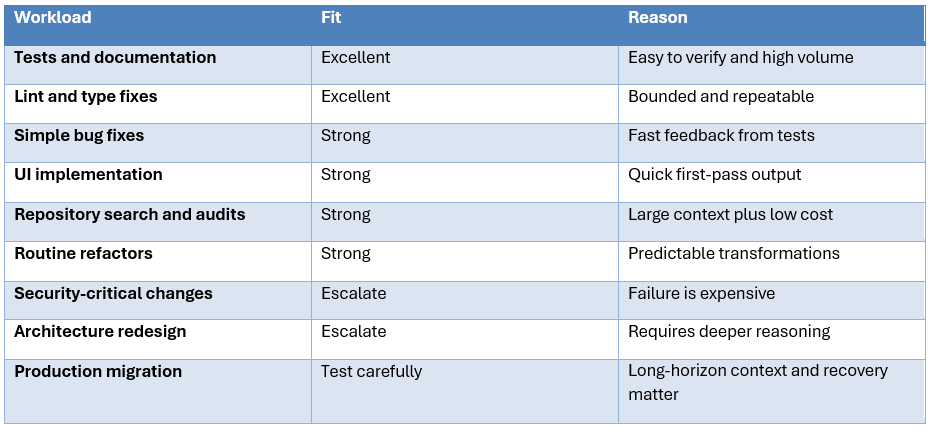
The point is not that Flash should replace premium models. The point is that a large amount of coding work does not require the maximum available intelligence.
6. Gemini 3.7 Flash vs Claude Sonnet 5
Sonnet 5 is the most direct competitor because it already occupies the role Google wants Flash to capture: a model developers can use broadly for real software engineering.
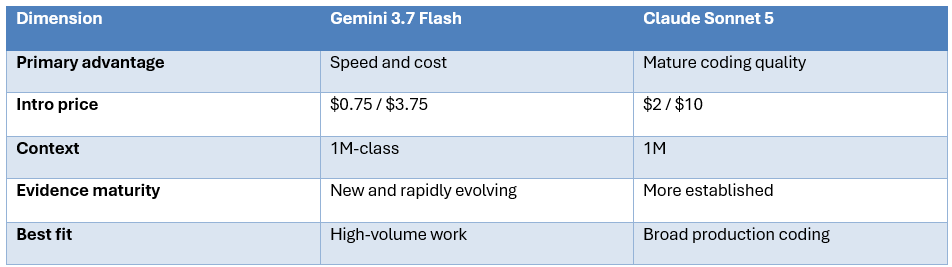
Sonnet 5 is still the safer buy for teams that value maturity. Gemini 3.7 Flash is the more aggressive economic bet. If a team can validate Flash on its own repositories and keep the same success rate, the cost difference is large enough to matter.
Use our Gemini 3.7 Flash vs Claude Sonnet 5 vs GPT-5.6 comparison for the broader head-to-head.
7. Gemini 3.7 Flash vs GPT-5.6 Sol
The price difference becomes even more dramatic against GPT-5.6 Sol. At $0.75/$3.75 versus $5/$30, Gemini 3.7 Flash costs roughly 85% less on both input and output during its introductory period.
That does not mean Sol is overpriced. Sol is designed for the most difficult coding-agent tasks, and premium reasoning can be worth paying for when a failed result consumes hours of engineering time.
The economic mistake is using Sol for everything. A better system lets Flash handle routine work and escalates only when task complexity justifies the premium.
That is the same logic behind GPT-5.6 Terra and Luna. OpenAI's tiered pricing shows that even one vendor now expects teams to route requests by difficulty instead of treating the highest model as a universal default.
8. Agentic Coding Is Where the Savings Multiply
A single developer might send a few dozen requests a day. A coding-agent platform can make thousands of model calls across code search, issue triage, tests, pull-request generation, documentation and maintenance.
At that scale, a small difference in token cost becomes a serious infrastructure cost. If a cheap workhorse can solve 60% to 80% of calls and a premium model handles only the difficult remainder, the blended cost can drop sharply.
The opposite is also true. Cheap automation that creates a flood of low-quality pull requests is not efficient. Teams need review capacity, tests, monitoring and security controls.
This is why the surrounding agent product matters. Our AI Coding Tools collection tracks the agent runtimes and IDEs that sit between the model and the developer.
9. Cheap Models Increase Security and Governance Pressure
Lower model prices make it easier to run more autonomous tasks. More autonomy means a larger attack surface.
Every agent execution can read files, call tools, access MCP servers, install packages or touch external systems depending on its permissions. If you double the number of agent runs without improving the surrounding controls, you also increase the number of opportunities for prompt injection, accidental credential exposure and unsafe changes.
Our How to Secure AI Coding Agents in 2026 covers permissions, sandboxing, MCP and secrets. Those controls matter even more when AI coding becomes cheap enough to run continuously.
10. What This Means for Startups
For startups, cheaper coding models can make automation financially practical much earlier. A small engineering team can afford to use agents for tests, documentation, audits, prototypes and maintenance without sending every request to a premium model.
That can increase development velocity, but it should not be confused with removing engineers. As code generation becomes cheaper, the scarce resource becomes technical judgment. Someone still needs to define architecture, validate behavior, review security, decide what matters and reject bad output.
The startup advantage is not generating more code. It is getting more validated software changes per engineering dollar.
11. What This Means for Enterprises
Enterprise teams can potentially save much more because model usage scales across hundreds or thousands of developers and automated workflows. But enterprise savings only matter if the model fits security and governance requirements.
That means identity boundaries, private networking, sandboxing, audit logs, secret isolation, approval gates and repository policies. A cheaper model that requires so many compensating controls that it becomes difficult to operate is not necessarily cheaper.
Gemini 3.7 Flash is most interesting for enterprises that can put a routing layer around it and reserve expensive models for higher-risk or higher-complexity work.
12. The Smartest Routing Strategy in 2026
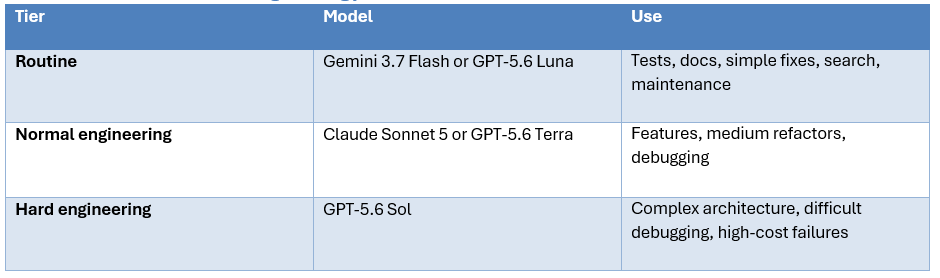
Routing can use simple signals such as number of files involved, task type, repository size, prior failure count, security sensitivity and whether external tools are required.
A smart agent can start with the inexpensive model and escalate when the evidence says it is struggling. That gives teams the best of both worlds: low average cost and access to frontier intelligence when it is actually necessary.
13. How to Measure Whether Flash Really Saves Money
Do not switch production traffic based on pricing tables alone. Run a controlled evaluation on your own codebase.
- Select 20 to 50 real issues.
- Give each model the same repository state and task description.
- Use identical tools and test commands.
- Measure first-pass acceptance.
- Track token use, retries and human correction time.
- Measure wall-clock completion time.
- Calculate cost per accepted change.
- Track security or policy violations separately.
For repeatable experiments, the Gen-AI-Experiments repository can be adapted into an evaluation harness.
Final Verdict: Is Gemini 3.7 Flash the Future of AI Coding Economics?
It is too early to claim that Gemini 3.7 Flash is the best coding model. It is fair to say that it is one of the most important price-performance moves in AI coding this year.
Gemini 3.7 Flash does not need to beat GPT-5.6 Sol at every hard engineering benchmark. It only needs to be good enough to solve a large share of everyday coding tasks while being much cheaper and faster.
That changes the economics of development. Premium models become escalation engines. Workhorse models become the default. Agent runtimes become routers. Cost per successful task matters more than cost per token.
My recommendation is to test Gemini 3.7 Flash aggressively on routine and high-volume coding. Keep Claude Sonnet 5 or GPT-5.6 Terra for normal production engineering. Reserve GPT-5.6 Sol for difficult tasks where extra reasoning clearly saves more money than it costs.
The coding-model race is moving from 'Who is smartest?' to 'Who can deliver enough intelligence, fast enough, at a price that makes automation profitable?' Gemini 3.7 Flash is one of the clearest signs that the second question is becoming the more important one.
13. The Hidden Economics of Developer Attention
There is another cost that token tables rarely capture: developer attention. A coding model can be cheap and fast while still forcing an engineer to spend time checking whether the output is correct. That review burden becomes important when teams increase automation volume.
A fast workhorse model changes the balance only when the surrounding workflow can verify its output cheaply. Tests, type checking, linting, screenshots, static analysis and pull-request review all become part of the economic system. The model is one component of the pipeline, not the whole pipeline.
This is why a model that produces a slightly better first draft can still lose on total economics if it is much slower. Conversely, a very cheap model can lose if its output requires extensive manual correction. The target should be minimum human effort per accepted change.
For engineering leaders, the most useful KPI is therefore not tokens per developer or requests per month. It is validated changes per engineering hour and the cost required to produce those changes.
14. Why Routing Will Matter More Than Model Loyalty
The model market is changing too quickly for one permanent winner to make economic sense. Gemini, Anthropic and OpenAI are all shipping multiple tiers, and the gap between a premium model and a workhorse model can change every few weeks.
A routing layer protects a team from that churn. If Gemini 3.7 Flash is the best value for routine coding today, use it. If a new model becomes faster next month, swap the route. If GPT-5.6 Sol becomes dramatically better on a specific engineering task, reserve it for that task.
This is a better long-term architecture than hard-coding one provider into every development workflow. It also creates a clean place to implement security rules, budget limits and escalation policies.
Frequently Asked Questions
Is Gemini 3.7 Flash good for coding?
Yes. Google launched it specifically for coding, software engineering and agent workflows. It is positioned as a high-throughput workhorse.
How much does Gemini 3.7 Flash cost?
The introductory API price is $0.75 per million input tokens and $3.75 per million output tokens through December 31, 2026. Standard pricing is scheduled to increase to $1.50 and $7.50 from January 1, 2027.
Is Gemini 3.7 Flash cheaper than Claude Sonnet 5?
Yes. Its introductory token prices are substantially lower than Sonnet 5's $2 input and $10 output rates through August 31, 2026.
Is Gemini 3.7 Flash better than GPT-5.6?
Not universally. GPT-5.6 Sol remains the stronger high-end choice on published coding-agent benchmarks. Gemini 3.7 Flash is much cheaper and can be the better option for routine work.
What is the best cheap AI coding model in 2026?
Gemini 3.7 Flash is one of the strongest low-cost coding options because of its combination of speed, coding focus and low API pricing. GPT-5.6 Luna is an even cheaper lower-tier option.
What is the fastest AI coding model?
Gemini 3.7 Flash is explicitly positioned as a fast workhorse. Exact end-to-end speed varies by model settings, endpoint, tool use and workload, so teams should benchmark the whole coding workflow.
Should startups use Gemini 3.7 Flash for coding agents?
Yes, it is worth evaluating for high-volume work. Startups should keep stronger models available for difficult architecture, security-sensitive changes and expensive failures.
Recommended Blogs
- Gemini 3.7 Flash Review: Benchmarks, Price & the Catch (2026)
- Gemini 3.7 Flash vs Claude Sonnet 5 vs GPT-5.6
- GPT-5.6 Review: Sol, Terra, Luna Features, Benchmarks, and Pricing
- Claude Sonnet 5 Review: Benchmarks, Pricing & Is It Worth It?
- How to Secure AI Coding Agents in 2026: Permissions, Sandboxing, MCP & Secrets
- Lovable Review: Vibe Coding at a $13.3B Valuation (2026)
Resources & Community
Join our community of 70,000+ AI enthusiasts and learn to build powerful AI applications! Whether you are a beginner or an experienced developer, Build Fast with AI helps you understand and implement AI in your projects.
- Website - buildfastwithai.com
- LinkedIn - Build Fast with AI
- Instagram - @buildfastwithai
- Founder Twitter - @satvikps
- Twitter - @BuildFastWithAI
Agentic AI Launchpad 2026
A structured 6-week cohort program that takes you from AI basics to building and deploying real-world agentic AI systems. Includes live sessions, expert mentorship, project reviews, and a builder community network.
Ready to go from learning to building? Join the next cohort. Agentic AI Launchpad 2026
Free AI Resources
Access free tools, workshops, and micro-learning to keep building:
- AI Workshops - Free resources, upcoming events & past recordings
- Unrot - Learn AI in 5 minutes a day (free micro-learning app)

