



There is no single best coding model in August 2026. GPT-5.6 Sol has the strongest established coding-agent benchmark record of these three, Claude Sonnet 5 offers an unusually strong balance of coding quality, agentic behavior and price, and Gemini 3.7 Flash is the new speed-first challenger that Google launched specifically around coding, software engineering and agent workflows. The interesting part is that the cheapest model can now be good enough for a large share of coding tasks, which makes model routing more important than loyalty to one provider.
The short version: use GPT-5.6 Sol for the hardest engineering work, use Claude Sonnet 5 as the safest default for serious day-to-day development, and test Gemini 3.7 Flash when speed and cost dominate. For the wider category, our AI Coding Tools collection tracks how the agent layer changes the answer.
As of August 17, 2026, GPT-5.6 Sol is the strongest answer if the question is simply which model has the best published coding-agent results. OpenAI reports an Artificial Analysis Coding Agent Index score of 80, 64.6% on SWE-Bench Pro, 72.7% on DeepSWE v1.1 and 88.8% on Terminal-Bench 2.1. Claude Sonnet 5 is close enough to be more interesting than a raw leaderboard would suggest, scoring 63.2% on SWE-Bench Pro and 80.4% on Terminal-Bench 2.1, while launching at $2 per million input tokens and $10 per million output tokens through August 31. Gemini 3.7 Flash is the wildcard: Google launched it on August 13 specifically for coding and agent workflows, with introductory API pricing of $0.75 input and $3.75 output per million tokens through the end of 2026. Its early benchmark results and user reports make it a serious value challenger, but it is too new for a definitive universal ranking.
The August 2026 Coding Model Rankings
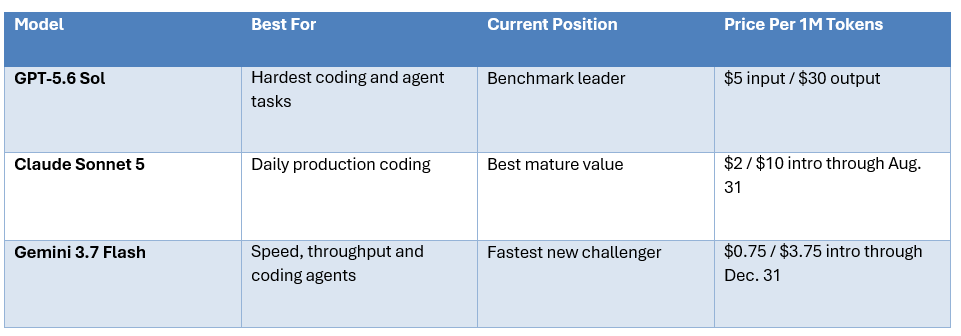
The price gap is substantial. Gemini 3.7 Flash is roughly 62% cheaper than Sonnet 5 on input and 62.5% cheaper on output during the introductory period. It is also dramatically cheaper than GPT-5.6 Sol. That means Gemini does not need to outperform Sol to become economically important. It only needs to be good enough.
1. Gemini 3.7 Flash: The New Workhorse
Google launched Gemini 3.7 Flash on August 13, four days before this comparison, positioning it as a workhorse model for coding, software engineering, web development and agent workflows. Reuters reported that the new model is focused on coding and automating business workflows, while Google's launch messaging emphasized better first-pass code, instruction following, planning and tool use.
Build Fast with AI already published Gemini 3.7 Flash Review: Benchmarks, Price & the Catch on August 14. That review is the deeper model-specific analysis, while this article asks a different question: how does 3.7 Flash stack up against Sonnet 5 and GPT-5.6 after the launch dust has settled?
The most important Gemini 3.7 Flash number is not a single benchmark. It is the price-performance curve. Google is offering the model at $0.75 per million input tokens and $3.75 per million output tokens through December 31, 2026, before scheduled standard pricing of $1.50 and $7.50 begins in 2027.
That puts Gemini 3.7 Flash much closer to the economics of a routing model than a premium coding model. If it can reliably solve ordinary tickets without repeated retries, it becomes extremely difficult for a developer platform to justify sending every request to a $5/$30 model.
My take: Gemini 3.7 Flash is the most important model in this comparison for one reason. It attacks the cost of competent coding rather than trying to win every frontier benchmark. That is exactly what can change developer workflows at scale.
2. Claude Sonnet 5: The Strongest Daily Default
Claude Sonnet 5 is the middle of the market in the best sense. It is much cheaper than GPT-5.6 Sol, but it is not a lightweight model. Anthropic designed it to close the gap with its larger Opus-class systems while making agentic coding, tool use and long-running work affordable.
Anthropic reports 63.2% on SWE-Bench Pro and 80.4% on Terminal-Bench 2.1. Its system card also reports 38.8% on FrontierCode v1 and 81.2% on OSWorld-Verified. These are meaningful because they test more than isolated code generation. They involve real repositories, terminals, tools and execution environments.
Our Claude Sonnet 5 Review covers the full benchmark and pricing story, including why Sonnet 5 is positioned as a more agentic Sonnet rather than simply a smarter chat model.
The pricing is also favorable right now. Anthropic's introductory price is $2 input and $10 output per million tokens through August 31, 2026. From September 1, the standard rate becomes $3 and $15. That deadline matters if you are benchmarking costs today because the same workload will become materially more expensive next month.
Sonnet 5's real strength is predictability. It already has a production track record, a mature coding ecosystem and established integrations. For teams that do not want to spend the next month tuning routing logic around a brand-new Flash model, Sonnet 5 is the easier choice.
3. GPT-5.6 Sol: Still the Peak Capability Pick
GPT-5.6 Sol remains the model to beat when the task is genuinely difficult. OpenAI describes it as its best coding model yet and reports an 80 score on the Artificial Analysis Coding Agent Index. Its coding table lists 64.6% on SWE-Bench Pro, 72.7% on DeepSWE v1.1, and 88.8% on Terminal-Bench 2.1. Sol Ultra reaches 91.9% on Terminal-Bench 2.1.
The full GPT-5.6 review covers the Sol, Terra and Luna tiers and why the family is designed for routing rather than one-model-fits-all usage.
The catch is price. Sol is $5 per million input tokens and $30 per million output tokens. Terra is now $2 per million input and $12 per million output after OpenAI's July 30 price cut, while Luna is $0.20 and $1.20. OpenAI explicitly positioned those reductions as a move toward stronger performance per dollar.
That makes the model selection problem more nuanced. Sol may be the best coding model, but Sol is not automatically the best coding purchase. If Terra or Luna can solve the task, buying Sol is simply paying for capability you are not using.
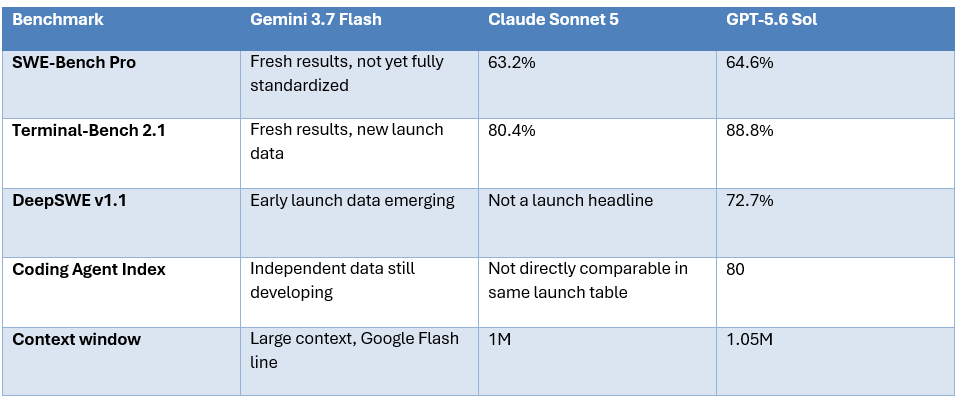
This is where you should be careful. The three models do not have a perfectly identical public benchmark sheet. Gemini 3.7 Flash is the newest, and the independent benchmark ecosystem is still catching up. The cleanest apples-to-apples evidence available today is therefore strongest for Sonnet 5 and GPT-5.6.
The benchmark conclusion is straightforward. GPT-5.6 Sol currently has the strongest published high-end coding record of the three. Sonnet 5 is close enough on core engineering benchmarks to be compelling at a lower price. Gemini 3.7 Flash has not yet earned an unconditional benchmark crown, but its launch economics make it the model that deserves the most real-world testing.
Do not turn a three-point difference into a universal ranking. Benchmarks are sensitive to harnesses, tool access, reasoning effort, prompts and sampling. The more interesting question is what happens when you give each model the same real repository and the same developer task.
5. Price Changes the Winner
Coding models are now cheap enough that the cost-per-token number can hide the real economics. A model that uses twice as many tokens or requires several retries can cost more than a seemingly expensive model that finishes in one pass.
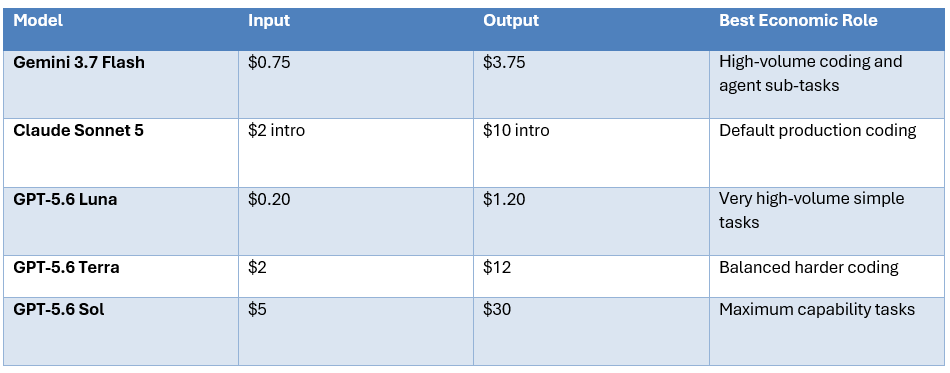
This is the clearest case for model routing. A company could send documentation, tests, small bug fixes and straightforward UI changes to Gemini 3.7 Flash or GPT-5.6 Luna, use Sonnet 5 or GPT-5.6 Terra for normal feature work, and reserve Sol for the hardest tasks. The best coding stack is increasingly a portfolio, not a single model.
6. Coding Agents: The Model Is Only Half the Product
A model benchmark does not tell you how good the final coding agent will be. Claude Code, Codex, Cursor and other tools add permission systems, terminal execution, repository indexing, context management, skills, hooks, MCP and cloud sandboxes around the underlying model.
That is why the Claude Code vs Codex comparison matters alongside this model comparison, and why Cursor Cloud Agents is a useful reference for how the runtime can change the developer experience.
For Gemini 3.7 Flash, this point is especially important. Google is positioning the model inside Gemini API, Google AI Studio, Android Studio, Antigravity and Gemini's agent experiences. Its value will depend on how smoothly those environments expose coding, context and tool execution, not merely how the base model scores.
7. Which Is Best for Large Codebases?
All three can operate over large contexts, but context length should not be treated as repository understanding. A million-token window is only useful if the model can select the right files, preserve architectural constraints and reason about dependencies.
GPT-5.6 Sol lists a 1.05M-token context window. Anthropic lists 1M for Sonnet 5. Google's Flash family also targets very large contexts. The real differentiator is how efficiently each model searches and reasons over that context.
For a large brownfield codebase, I would choose Sonnet 5 or Sol for the most complex architectural changes and test Gemini 3.7 Flash on repository navigation, audit, refactoring and repetitive maintenance tasks. The model that needs the fewest retries wins, even if its benchmark score is not the highest.
8. Which Is Best for Frontend and UI Coding?
Gemini 3.7 Flash is especially interesting for frontend because Google's launch messaging emphasizes web development, first-pass code accuracy and design adherence. This matters for teams that build landing pages, dashboards and component-heavy web applications.
GPT-5.6 Sol remains the safer choice when frontend work becomes a full-stack engineering task involving APIs, data models, tests and complex state management. Sonnet 5 is the middle ground, with enough reasoning depth for multi-file UI work while remaining affordable for repeated iteration.
For production UI work, test the models on your real design system instead of a fresh blank page. The strongest model is the one that respects your components, tokens, accessibility requirements and existing layout constraints without needing constant correction.
The latest Build Fast with AI content also includes our Lovable Review, which is useful as a comparison point because vibe-coding platforms increasingly wrap models in their own application-building workflows.
9. Which Is Best for High-Volume Coding?
This is where Gemini 3.7 Flash has the clearest opportunity. Its introductory API pricing is far below Sonnet 5 and GPT-5.6 Sol, and early reports emphasize very high generation speed.
For bulk tasks such as test generation, documentation, code search, simple refactors, type fixes, lint corrections and routine UI changes, the fastest adequate model often wins. The most intelligent model does not need to be involved in every request.
GPT-5.6 Luna is the other model to watch here because OpenAI's July 30 price cut pushed Luna down to $0.20 input and $1.20 output per million tokens. It is a different way to compete with Gemini: instead of a new model focused on coding speed, OpenAI is making an existing model extraordinarily cheap.
10. My Ranking for August 17, 2026
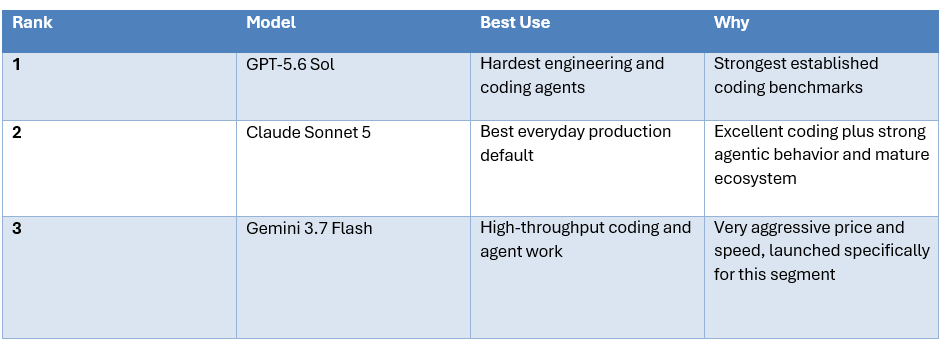
This ranking is about overall reliability and evidence, not pure price. If the category were 'best value,' Gemini 3.7 Flash could reasonably be number one. If the category were 'best raw coding capability,' GPT-5.6 Sol is number one. If the category were 'best production default,' Sonnet 5 is the model I would deploy first.
11. The Smartest Setup Is Not One Model
For most engineering teams, a three-layer stack makes more sense than standardizing on one premium model.
- Cheap executor: Gemini 3.7 Flash or GPT-5.6 Luna for routine code and high-volume tasks.
- Default engineer: Claude Sonnet 5 or GPT-5.6 Terra for normal feature work and repository maintenance.
- Escalation model: GPT-5.6 Sol for difficult architecture, long-horizon debugging and tasks where failure is expensive.
That routing strategy also reduces vendor lock-in. If a new model arrives next month that is faster than Gemini 3.7 Flash or more capable than Sol, you change one routing rule instead of rebuilding your entire coding workflow.
12. How to Test the Three Models Yourself
Public benchmarks tell you where to start. Your repository tells you which model to buy.
- Take 20 to 50 real coding tasks from your issue tracker.
- Give all three models the same repository state and instructions.
- Use the same tool permissions and test commands.
- Track first-pass acceptance, not just generated code.
- Measure tokens, wall-clock time and retry count.
- Score maintainability and correctness with human review.
- Record any security or policy violations separately.
- Calculate cost per accepted change.
For repeatable experiments, the Gen-AI-Experiments repository is a good base for building a model evaluation harness.
Final Verdict: Which Coding Model Is Actually Best?
GPT-5.6 Sol wins on established high-end coding capability. OpenAI's published numbers give it the strongest overall case on the benchmark side, including an 80 Coding Agent Index score and 88.8% Terminal-Bench 2.1.
Claude Sonnet 5 is the better all-around default if you care about performance, mature workflows and price together. Its 63.2% SWE-Bench Pro and 80.4% Terminal-Bench 2.1 results are close enough to frontier leaders that most teams will get more value from its lower price than from paying for Sol on every request.
Gemini 3.7 Flash is the most disruptive challenger because it changes the economics. At $0.75/$3.75 during its introductory period, it can be used as a high-volume coding workhorse without the cost profile of a premium model. It does not need to become the best model in the world to become the most important model in many development pipelines.
So the answer is not one logo. For the hardest tasks, GPT-5.6 Sol. For a default production model, Claude Sonnet 5. For high-volume coding, Gemini 3.7 Flash. And for teams that care about cost enough to route aggressively, add GPT-5.6 Luna and Terra to the mix.
Frequently Asked Questions
Which is better for coding, Gemini 3.7 Flash or Claude Sonnet 5?
Claude Sonnet 5 is the safer default today because its benchmarks, pricing and production ecosystem are more established. Gemini 3.7 Flash is the more aggressive value challenger and is worth testing for high-volume coding.
Is GPT-5.6 better than Claude Sonnet 5 for coding?
GPT-5.6 Sol has stronger published high-end coding numbers, especially on Terminal-Bench 2.1. Sonnet 5 is cheaper and competitive enough that it may be the better economic choice for many teams.
What is the best AI coding model in August 2026?
GPT-5.6 Sol is the strongest raw-capability choice, Claude Sonnet 5 is the strongest mature default, and Gemini 3.7 Flash is the strongest new value challenger.
Is Gemini 3.7 Flash cheaper than Claude Sonnet 5?
Yes during the introductory period. Gemini 3.7 Flash is $0.75 input and $3.75 output per million tokens through December 31, 2026. Claude Sonnet 5 is $2 and $10 through August 31, then rises to $3 and $15.
Which coding model has the best SWE-Bench Pro result?
Among the directly comparable published results used here, GPT-5.6 Sol is at 64.6% and Claude Sonnet 5 is at 63.2%. Gemini 3.7 Flash is newer, and a fully standardized independent comparison is still developing.
Which AI model is best for coding agents?
GPT-5.6 Sol is the strongest established choice for difficult coding agents. Sonnet 5 is better for a cost-conscious default. Gemini 3.7 Flash is a strong option for high-throughput agent workloads.
Which model is cheapest for coding?
Gemini 3.7 Flash is currently one of the strongest cheap coding options at $0.75 input and $3.75 output per million tokens during its introductory period. GPT-5.6 Luna is even cheaper at $0.20 and $1.20, but it targets a lower capability tier.
Should I use Gemini 3.7 Flash instead of GPT-5.6?
Do not make a blanket replacement. Route routine work to Gemini 3.7 Flash or GPT-5.6 Luna, use Sonnet 5 or Terra for normal feature work, and keep Sol for difficult tasks.
Recommended Blogs
- Gemini 3.7 Flash Review: Benchmarks, Price & the Catch (2026)
- GLM-5.3 Review: Is It Really As Good As Fable 5?
- How to Run Qwen3.8-Max Locally: 397GB Build & Hardware (2026)
- Lovable Review: Vibe Coding at a $13.3B Valuation (2026)
- Claude Sonnet 5 Review: Benchmarks, Pricing & Is It Worth It?
- GPT-5.6 Review: Sol, Terra, Luna Features, Benchmarks, and Pricing
Resources & Community
Join our community of 70,000+ AI enthusiasts and learn to build powerful AI applications! Whether you are a beginner or an experienced developer, Build Fast with AI helps you understand and implement AI in your projects.
- Website (buildfastwithai.com)
- LinkedIn (Build Fast with AI)
- Instagram (@buildfastwithai)
- Founder Twitter (@satvikps)
- Twitter (@BuildFastWithAI)
Agentic AI Launchpad 2026
A structured 6-week cohort program that takes you from AI basics to building and deploying real-world agentic AI systems. Includes live sessions, expert mentorship, project reviews, and a builder community network.
Ready to go from learning to building? Join the next cohort. Agentic AI Launchpad 2026
Free AI Resources
Access free tools, workshops, and micro-learning to keep building:
- AI Workshops - Free resources, upcoming events & past recordings
- Unrot - Learn AI in 5 minutes a day (free micro-learning app)
The coding-model race is no longer about choosing one permanent winner. Test models on your own repository, route work by difficulty, and pay for frontier intelligence only when the task actually requires it.
References
- Google Gemini 3.7 Flash launch coverage
- Google announcement mirror with pricing and rollout details
- Anthropic - Introducing Claude Sonnet 5
- Anthropic - Claude Sonnet 5 System Card
- OpenAI - GPT-5.6
- OpenAI - GPT-5.6 price-performance update
- Build Fast with AI - Gemini 3.7 Flash Review
- Build Fast with AI - Claude Sonnet 5 Review

